CXMT's denser DRAM claim puts a question mark over memory's AI pricing power
China's largest memory maker says a 4F-squared server module will ship this year. The claim is thin on detail, but it targets the most profitable corner of the AI chip boom.
The most valuable commodity in the artificial intelligence build-out this autumn is not a graphics processor. It is memory. That is why a short speech in Shanghai on Saturday deserves more attention from investors than its length would suggest. Cao Kanyu, president of ChangXin Memory Technologies (CXMT), told the Integrated Circuits and Chiplet Conference on October 10 that the company intends to launch a new generation of DDR5 registered memory modules for servers before the end of 2026, built on a 4F-squared cell architecture that the world's three dominant DRAM makers have so far shown only in research form.
The claim arrives two days after Samsung Electronics put a number on how profitable the memory shortage has become. Its preliminary third-quarter results, published on October 8, showed operating profit of 107.4 trillion won, up 782.5 per cent from a year earlier, on revenue of 195 trillion won. A credible challenger with a cheaper way to pack bits onto silicon is precisely the risk that such margins invite.
What CXMT actually said
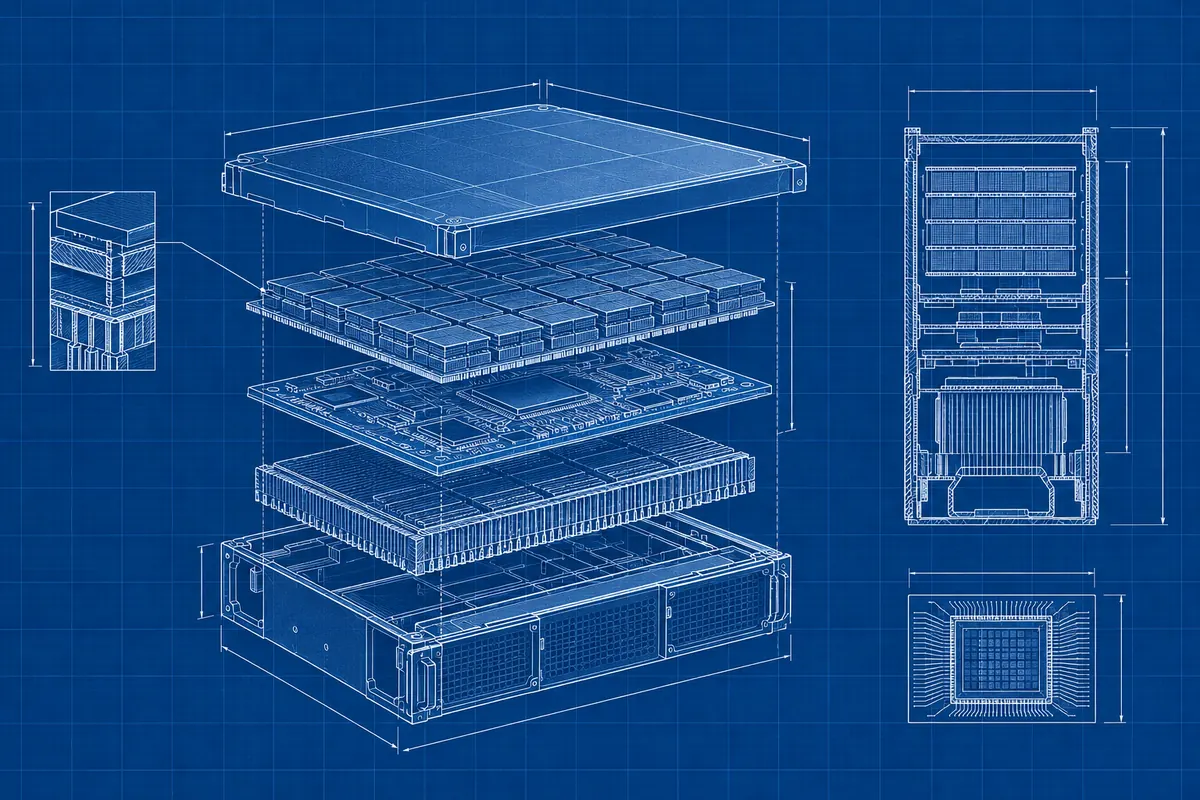
The industry's mainstream DRAM designs use a 6F-squared cell, a measure of the area each memory cell occupies relative to the smallest feature the process can print. A 4F-squared cell shrinks that footprint. Chinese hardware outlet MyDrivers, cited by TrendForce, estimates the gain at 30 to 50 per cent more density in the same area. CXMT's approach rests on what it calls a vertical surrounding-gate transistor, which stands the transistor upright to save space and improve control of current leakage, combined with separate fabrication of the memory array and the peripheral logic, joined by wafer-level hybrid bonding.
Mr Cao said the company holds more than 300 published patent families related to the architecture, and that server memory will be its first application. The choice is deliberate. According to the Chinese business daily Yicai, as reported by TechNode, CXMT has historically leaned on consumer electronics, and its server business contributed more in the first half of 2026. Server buyers, however, demand modules that run continuously without failure, a standard that consumer parts do not have to meet.
What the speech did not include matters as much as what it did. No specifications, no capacity figures, no yields and no firm launch date were disclosed. TrendForce, summarising Korean press reports, noted that the forthcoming products may adopt the new cell only in part, and drew the distinction that commercial availability "does not necessarily signal readiness for high-volume production."
Why the target is server DDR5
For two years the investment narrative in memory has been dominated by high-bandwidth memory, the stacked chips that sit beside AI accelerators. That story has not gone away: TrendForce attributes a meaningful part of Samsung's third-quarter result to sales of HBM4 for Nvidia's Vera Rubin systems. But conventional server memory has quietly become just as lucrative. TrendForce has found that revenue per wafer from 64GB DDR5 server RDIMMs overtook HBM in the first quarter of this year, with stronger estimated profitability, as AI data centres absorbed ordinary DRAM alongside the exotic kind.
That is the segment CXMT is aiming at, and it is the segment where a newcomer can most plausibly compete. HBM requires advanced stacking and close qualification with accelerator designers. Registered DDR5 modules are a more standardised product, sold to hyperscalers and server makers who care about price, reliability and supply security. In a market where supply is short, the third of those can outweigh the first two.
A challenger with capital and customers
CXMT is no longer a subsidised outsider. It listed on Shanghai's STAR Market on July 27 under the code 688825, raising more than 57.9 billion yuan in the base offering and about 66.6 billion yuan if the over-allotment option is fully exercised, according to Deloitte China, which advised on the listing. The Korea Herald has described it as the largest Asian IPO of the year. Reuters has reported that new fabs in Shanghai and Hefei could more than double its monthly wafer capacity to over 600,000, and that it has signed supply deals worth more than $3bn with Tencent and more than $7bn over five years with ByteDance.
Its share of the market is rising quickly. TrendForce data show CXMT's share of global DRAM revenue climbing to 9.5 per cent in the second quarter from 7.6 per cent in the first, placing it fourth behind Samsung on 39.4 per cent, SK hynix on 24.9 per cent and Micron on 23.3 per cent. In September the company announced mass production of its fifth-generation DRAM platform and of LPDDR6 mobile memory. The 4F-squared announcement is the next step in a sequence, not an isolated boast.
The incumbents are not standing still. Samsung presented a working 16Gb 4F-squared prototype using wafer-to-wafer hybrid bonding at the ISSCC conference in February, though Korean press reports cited by TrendForce suggest it does not expect market availability before 2028. SK hynix has published research on its own vertical-gate 4F-squared design. Both have chosen, rationally, to pour engineering effort into HBM while the AI boom pays for it. CXMT is betting that this leaves an opening a generation below.
The limits of the claim
Investors should be careful not to confuse a smaller cell with a cheaper chip. Denser designs need more complex structures and more process steps, and early yields are typically poor, all of which can erase the theoretical savings. CXMT has not shown manufacturing costs for the new architecture, and the headline density gain assumes the same minimum feature size, so a rival printing finer features on a conventional cell can close much of the gap. There is also the question of tools. Chinese manufacturers remain constrained by Western export controls on advanced chipmaking equipment, which helps explain why a change in cell structure, rather than a finer process, is an attractive route for CXMT.
Nor is CXMT a price disruptor today. Reuters has reported that it charged some Chinese customers more than Samsung's roughly $1,240 price for comparable 64GB DDR5 server modules. In a shortage, every supplier prices to the market, and the newcomer is no exception.
Our view
The announcement is a claim, not a product, and nothing in it changes memory supply this year. But it alters the shape of the risk that investors in the AI hardware chain are carrying. The extraordinary profits now flowing to Samsung, SK hynix and Micron rest on scarcity, and scarcity in memory has historically ended the same way: a new entrant adds capacity, a technology step lowers cost per bit, and prices fall faster than anyone forecast. CXMT now has both the balance sheet from its IPO and an architectural story to go with it.
For founders building AI infrastructure, the more competitive memory market that may follow would be welcome, since server memory has become one of the fastest rising costs in a rack. For investors, the signals to watch are concrete: whether CXMT publishes specifications and yields, whether any hyperscaler outside China qualifies its modules, and whether Samsung and SK hynix bring their own 4F-squared timetables forward. Until then, the claim is best read as a reminder that memory remains a cyclical business, however structural the AI boom looks.
Sources
- TechNode: CXMT plans next-generation DDR5 server memory using denser DRAM architecture
- TrendForce: CXMT accelerates 4F² DRAM push, eyes year-end server DDR5 RDIMM launch
- TrendForce: Samsung sees 3Q26 operating profit soaring 783% to record KRW 107.4 trillion
- Deloitte China: Deloitte China assists listing of CXMT on SSE STAR Market
- The Korea Herald: China's CXMT pushes into next-gen DRAM, but can it compete on cost?
Filed under AI. Written by Invest Times Editorial under our editorial standards. Commentary and analysis for information only, not investment advice.