1Komma5° raises at $1.35bn to turn a solar installer into an energy software company
The Hamburg group's oversubscribed round, its first aimed squarely at its Heartbeat energy AI, asks investors to value hardware cash flow and a software option together.
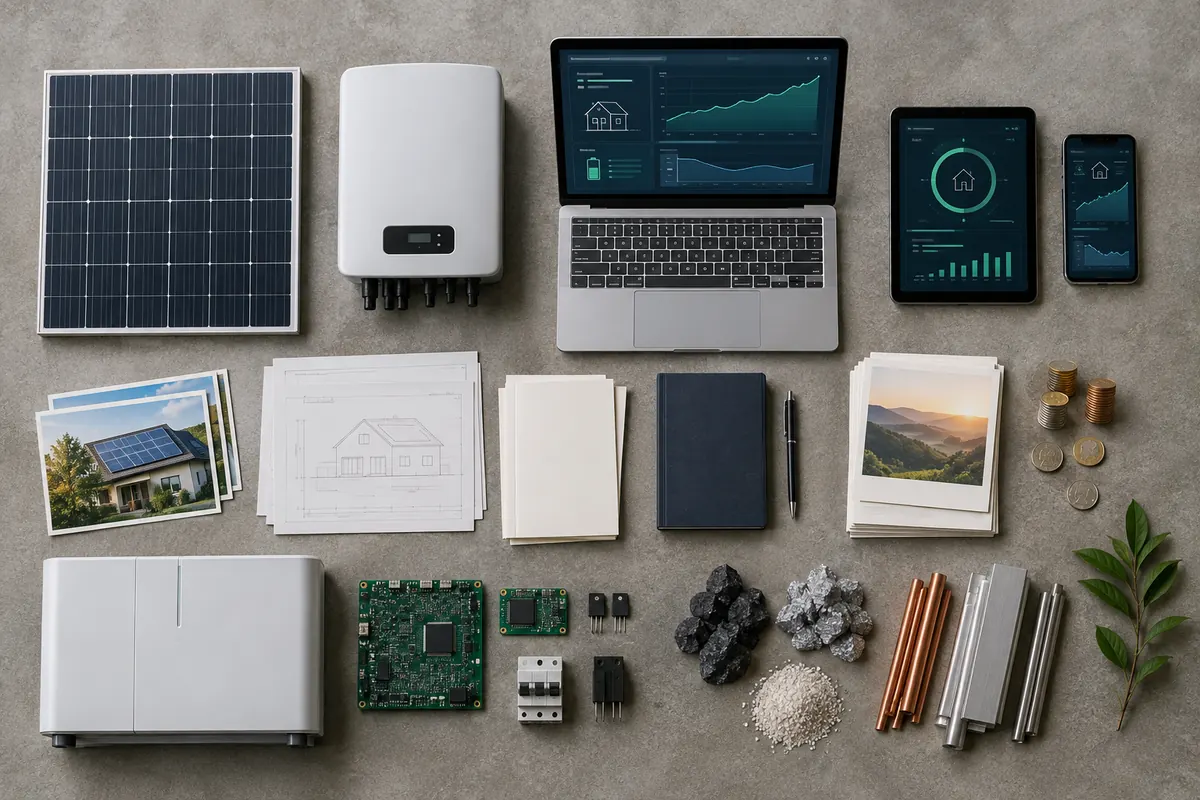
1Komma5°, the Hamburg company that installs rooftop solar panels, batteries and heat pumps across Europe, said on Tuesday, 13 October, that it is raising more than €70m in a new round at a pre-money valuation of $1.35bn, or roughly €1.2bn. The figure is 35 per cent above the valuation set in its previous round in July 2025. The round is led by b2venture, with the Japanese growth fund Marunouchi Innovation Partners joining as a new shareholder and existing backers CalSTRS, eCapital, G2 Venture Partners and Eurazeo taking part. Reuters first reported the valuation on Monday, 12 October, after speaking to chief executive Philipp Schröder.
The money is not intended for more vans and installers. The company says it will spend more than €100m in 2027 on Heartbeat AI, its software for controlling household energy systems and trading their flexibility on power exchanges, with about €35m of that coming from operating cash flow. Co-founder and chief financial officer Micha Grüber described it as the first round focused specifically on the energy AI business, and said it was oversubscribed. That framing is the real news: a hardware-heavy unicorn is asking investors to price it increasingly as a software platform.
From installer to virtual power plant
1Komma5° was founded in 2021 and has grown largely by buying and integrating regional installation businesses. According to the company, it now operates at about 80 locations in seven markets, employs about 3,000 people and has installed more than 300,000 decentralised, controllable energy systems. Its stated ambition is to move more than 1.5 million buildings to renewable supply by 2030.
Heartbeat is the layer that sits on top of that installed base. It connects batteries, heat pumps, solar arrays, electric vehicle chargers and air conditioning units, decides when they should draw or deliver power, and sells electricity on the exchange on the customer's behalf. The company says the system now aggregates more than 1 GW of flexible capacity across five markets and optimises more than 100,000 systems, which it describes as one of the largest household virtual power plants in Europe. Trending Topics reported a target of 20 GW by 2030.
The commercial logic is straightforward. Each installation is a one-off sale with installer margins; each connected device is a potential source of recurring revenue from energy trading, billing and metering. Trending Topics reported that the software's annualised revenue recently reached about €30m, nearly double the previous year. Against a group revenue forecast of about €700m for 2026 (Dealroom and Impact Loop, citing the company's September guidance, put the target at around $750m), the software business remains small. The round is a bet that it will not stay that way.
Policy is doing some of the selling
German policy is helping. Trending Topics notes that the planned phase-out of feed-in tariffs for rooftop solar is lifting demand, because households that can no longer rely on a fixed statutory payment for surplus power need another way to monetise it. Schröder made the point directly in September, saying Heartbeat would take over the role of the former fixed remuneration in a free market. The company says new customer orders in Germany rose almost 50 per cent year on year in September.
That is an attractive tailwind, but it is also a dependency. Business models built on regulatory change can be undone by further regulatory change, and the economics of household flexibility depend on wholesale price volatility, grid operator rules and the willingness of customers to cede control of their devices. None of these is fully in the company's hands.
The numbers behind the step up
The valuation rise looks less dramatic once the history is considered. 1Komma5° was already valued at more than €1bn in 2023, and at the end of 2024 it raised €150m in what was billed as the last round before a stock market listing. Trending Topics also recalls that in 2024 the company missed its revenue targets by about €200m. In other words, the new price restores and modestly extends a valuation the company had reached three years ago, rather than marking a leap. Dealroom places the valuation around the middle of comparable late-stage deals.
The balance sheet story is more reassuring. The company says its core hardware business is profitable at the EBITDA level and cash-flow positive, and Trending Topics reported expected operating EBITDA of about €40m from that business. It says it is debt-free and has arranged financing facilities of up to €1.5bn with banks for its public-sector and private customer segments, which sit off its balance sheet. Investors will want to understand how those facilities are structured, since off-balance-sheet customer financing can transfer risk in ways that headline leverage figures do not show. Organic revenue growth for 2026 is guided at 35 to 40 per cent.
Peers offer a useful frame. Trending Topics reported that Berlin-based Enpal expects revenue above €1.3bn this year, up 18 per cent, while the heat pump installer Thermondo targets €275m. 1Komma5° is growing faster than Enpal from a smaller base, and is the most explicit of the three in pitching software as its future.
The listing question returns
The round also reopens the question of an initial public offering. The company had prepared a Nasdaq listing, which it shelved in 2025 after US energy and trade policy under President Donald Trump unsettled markets. Schröder told Reuters that performance in 2027 will decide whether and when a US listing happens, and that the company plans to enter the US market next year. Marunouchi Innovation Partners, which has experience with US investments in energy and flexibility, is expected to help with that move. At Slush in November 2025, Schröder had said a European listing would also be seriously considered.
Entering the US before listing there is a sensible sequence. American public market investors would want evidence that the Heartbeat model works outside Europe's regulatory environment, and a market where utility structures differ from state to state is a demanding test.
Our view
This is a well-judged round, more than a spectacular one. 1Komma5° is using a profitable hardware business to fund a software ambition, and is raising only a modest sum against a valuation it first reached in 2023. That discipline is welcome in a climate technology sector where many companies raised too much, too early, on too little revenue.
The harder question is how investors should price the mix. At about €30m of annualised software revenue against roughly €700m of group sales, Heartbeat is still an option rather than the core. If it scales towards the 20 GW target, 1Komma5° could earn a software multiple on part of its business; if it stalls, the company remains a well-run installer exposed to subsidy cycles and interest rates. For founders in energy hardware, the lesson is to build the recurring layer early and report it separately. For investors, the figures to watch are Heartbeat revenue disclosed on its own, the terms of the €1.5bn financing facilities, and whether the US entry in 2027 produces paying customers before it produces a prospectus.
Sources
- 1KOMMA5°: 1KOMMA5° secures new funding for its energy AI at a 35 percent higher valuation
- Trending Topics: 1Komma5° raises €70 million as its IPO waits
- Impact Loop: Energy tech unicorn 1Komma5° raises at €1.2bn valuation, weighs IPO in the US
- Dealroom News: 1KOMMA5° hits $1.35B valuation, eyes US expansion
- Startup City Hamburg: 1KOMMA5° secures 70 million euros in a new round of funding
Filed under Startups. Written by InvestTimes Editorial under our editorial standards. Commentary and analysis for information only, not investment advice.